













Reconciliation built for real estate, on Yardi
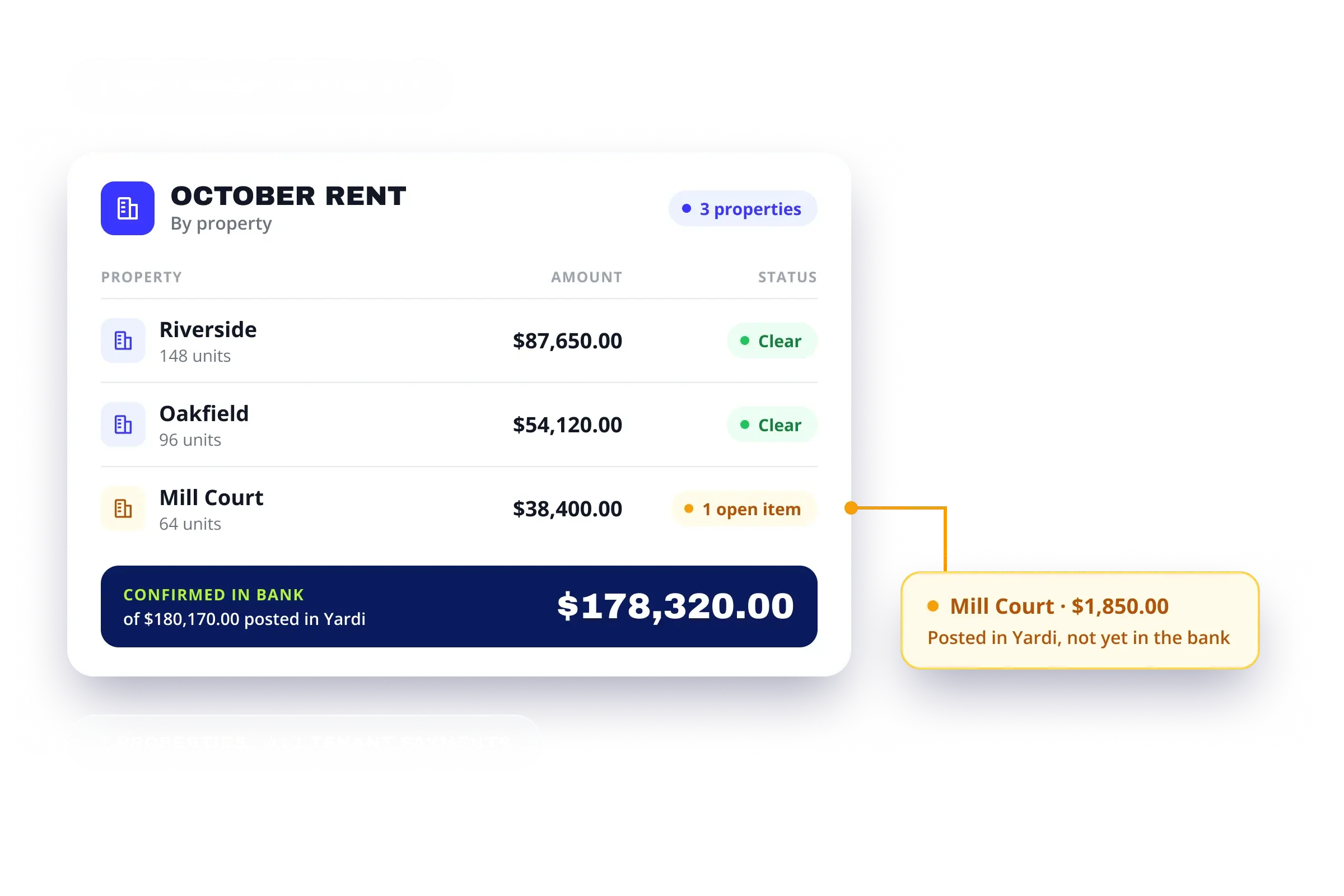
Rent, fees, and sale proceeds are charged in Yardi, but the money reaches your bank through ACH, cards, resident portals, lockbox, and checks, net of fees and rarely on the same day. LedgerMatch sits between the two. It matches what your books say you were owed against what the bank actually received, clears everything that agrees, and hands your team only the payments that do not.
Be one of the first on Yardi
The direct Yardi integration is being built now, with a small group of founding customers who help shape it. Join during the build and you set the terms you reconcile on.
50%
off the service
For founding customers who join during the build.
Become a founding customerWhat to expect
- 50% off the service as a founding customer, from your first month
- The Yardi integration is built once two or three founding customers are on board, and delivered about a month from there. There is no fixed launch date before then.
- You use LedgerMatch in your live environment and help the team validate the integration, responding promptly while it is built.
- You share a short case study once it is working. A review is optional.
Key features
What the software does, from the moment your data arrives to the moment the period is signed off.
Your data prepared for matching


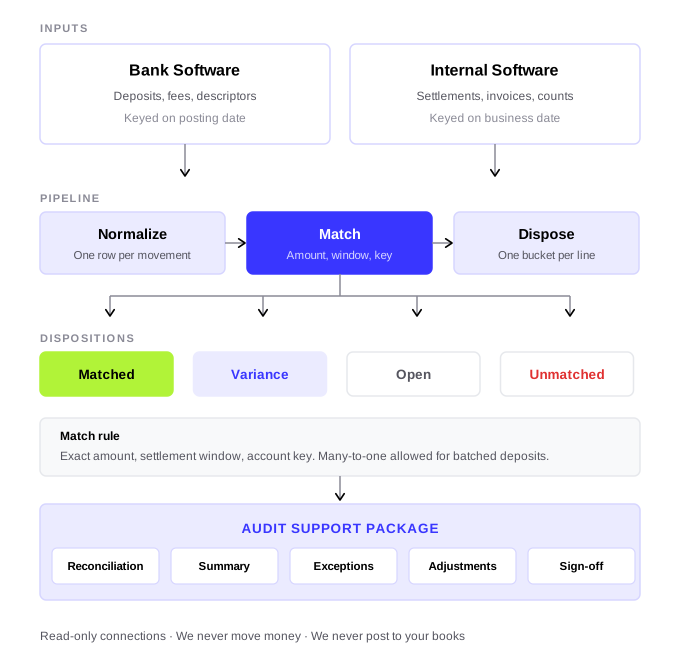
Your books and your bank describe the same money in different ways. LedgerMatch lines the two up before anything is matched, and your original records are never changed.
- Puts amounts in one format and reads deposits as money in
- Labels each line as rent, fee, deposit, or return
- Keeps both the date it happened and the date it posted
- Adds calculated fields like net after fees, without touching your data


Matching that handles bundled deposits
One deposit often pays many tenants at once, so the two sides rarely line up one to one. LedgerMatch matches against the rules you set, and AI catches what the rules would miss.
- Matches on amount, a date window, and a reference, never date alone
- Groups many tenants into the single deposit that paid them
- AI proposes the harder matches, your team approves them
- Up to 95% of payments match automatically
Every deduction accounted for


A deposit almost always arrives smaller than the rent that was due. LedgerMatch separates each deduction and applies the tolerance you set.
- Keeps fees, late fees, and returns as separate figures
- Clears small differences inside your tolerance automatically
- Flags anything above it, with the reason attached


Every account reconciled separately
Operating and trust funds are never mixed. LedgerMatch keeps each account on its own, property by property, so every balance can be shown to tie out.
- Operating and trust accounts matched separately
- Kept clean property by property
- Nothing crosses between accounts
Audit-ready from the first match


Every match, change, and approval is recorded as you go. Backing an owner statement or an audit becomes an export, not a scramble.
- Who matched and who approved, saved on every line
- Reconciliation, exceptions, and audit log in one package
- Export it the moment an owner or auditor asks
Built for real estate teams on Yardi
One engine reconciles the money coming in for any kind of portfolio. As you add properties, accounts, and payment channels, you do not add another tool.

Residential and multifamily managers
Hundreds of tenants paying rent across units, portals, and processors, reconciled to the deposit that actually cleared.

Commercial and retail operators
Base rent, CAM, and percentage charges arriving on different dates, tied back to what each tenant was billed in Yardi.

Real estate developers and owners
Proceeds, deposits, and installments across projects and entities, each reconciled to its own bank account.

HOA and community associations
Dues, assessments, and special charges across many owners, kept clean per association and per bank account.
Benefits of automating your Yardi reconciliation
It changes more than your month-end. Here is what it means day to day.

Close the whole portfolio faster
Most of the rent roll is already reconciled before you sit down. What took days across properties takes an afternoon.

No more matching rent by hand
You stop ticking Yardi receipts against bank lines one by one, and look only at what did not match.

Catch missing rent the day it happens
A payment that never arrived, a returned NSF, or a duplicate shows up right away, not when the owner asks at month-end.

Keep trust accounts clean
Operating and trust funds stay reconciled separately, so you can show each account ties out, exactly as the rules expect.

Owner reports and audits ready anytime
The proof behind every match and sign-off is already saved. When an owner or auditor asks, you export it instead of rebuilding it.

You set the rules and approve every match
The software does the work, but nothing is hidden and nothing is matched or signed off without you.
How it works
Bring your sources together once, and each reconciliation runs the same clear way, month after month.
Bring in your Yardi data and bank
Export your charges, receipts, and deposits from Yardi, and connect your bank with a read-only connection. A direct Yardi integration is on the way.
LedgerMatch matches it for you
It pairs every deposit to what your books say you were owed, using your rules and accounting for fees and timing on its own.
You review only what did not match
Up to 95% clears itself. What is left is shown with the reason, so your team looks only at what needs a decision.
Each account ties out and exports
Every match and approval is recorded, ready to export for an owner statement or an audit the moment it is asked for.
Security and compliance built in

The bank connection can never move money
LedgerMatch reads your transactions and nothing more. It can see what came in, but it can never move a cent, which matters most on trust accounts.
Encrypted, with access set by role
Data is encrypted in transit and at rest, and role-based permissions mean each person sees only the properties and accounts they should.
Security program aligned with ISO 27001
Our security program follows a structured framework based on ISO 27001, the international standard for managing information security.
Tested inside and out
We run regular internal and external scans and penetration testing, simulating attacks from both sides to find and fix weaknesses early.
FAQs
