













© Urenkoff 2025
The full procedure, the manipulations it is designed to catch, the red flags that matter, and why a reconciliation that balances perfectly is often the one worth looking at hardest.
A bank reconciliation that balances proves almost nothing on its own. Any competent person can make two numbers agree given an afternoon and a spreadsheet. What an audit tests is not whether the totals meet, but whether every difference between them is real, supported, and explained by something other than the need to reach a total.
Cash is also the account where manipulation is easiest to attempt and easiest to detect, because it is the only balance in the financial statements that a third party will independently confirm. That makes the bank reconciliation one of the highest value pieces of audit work available, and one of the most revealing documents a finance team produces.
This guide covers what to test, in what order, how deep to go, what the warning signs look like, and what separates a reconciliation that survives an audit from one that merely looks tidy.
What is actually being tested
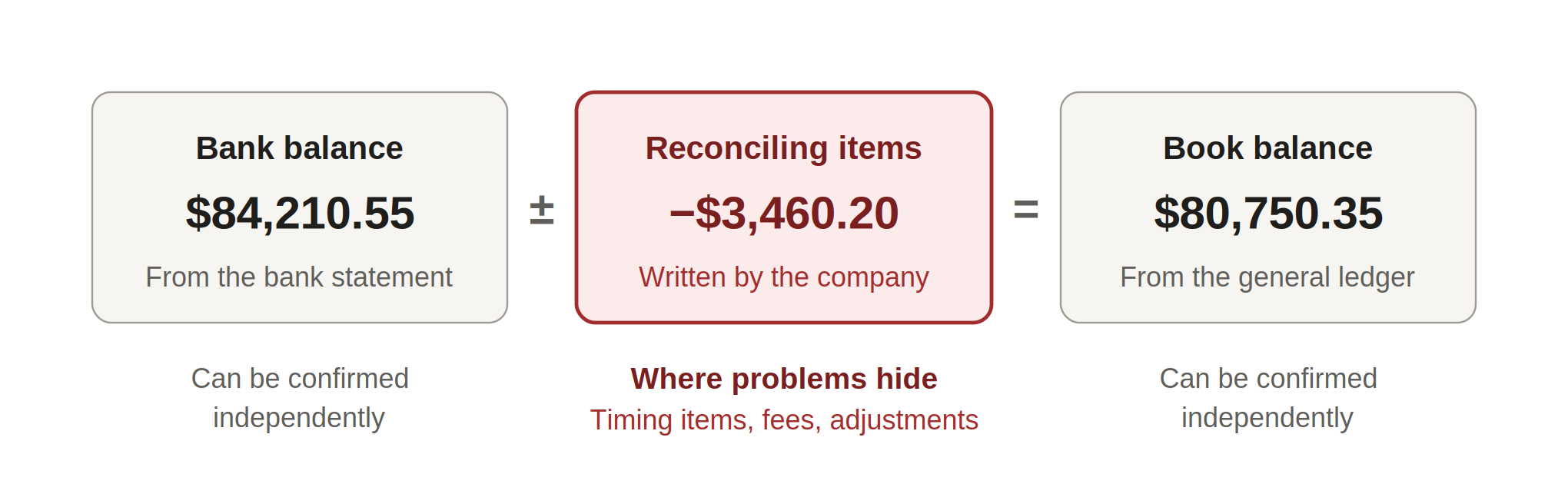
Strip away the schedules and a bank reconciliation makes three claims. The audit is the process of checking each one.
- The bank balance is real. The figure at the top is what the bank says, not what the company says the bank says.
- The book balance is real. The figure at the other end agrees to the general ledger, not to a working paper that has drifted from it.
- Everything in between is explained. Each reconciling item is a genuine timing difference or a known error, supported by evidence, and it will be clear.
Most weaknesses live in the third claim. The two balances are usually easy to confirm. The reconciling items are where problems hide, because they are the only part of the reconciliation the company writes itself. Everything else comes from somewhere.
The reconciliation that never has open items
A perfectly clean reconciliation, month after month, is not necessarily good news. Real bank accounts produce timing differences, late deposits and bank charges nobody booked. A reconciliation that always lands exactly on zero may mean the differences are being absorbed rather than reported.
Who is auditing, and how deep that goes
The same document gets examined by three different people with three different levels of scepticism, and knowing which one you are changes the work.
- The reviewer inside finance. Checking that the preparer did the job. Usually monthly, usually focused on the open items and whether they are clearing.
- Internal audit. Testing whether the control operates as described, across a period rather than at a point. More interested in the pattern than in any single reconciliation.
- The external auditor. Testing the cash balance in the financial statements, and forming a view on whether the reconciliation is reliable enough to rely on. This is the deepest examination and the one everything else should be designed to survive.
A useful rule when preparing: assume the person reading it does not trust you, does not know your business, and cannot ask you a question. Anything that fails that test needs more support.
Two separate things are being tested
This distinction is frequently collapsed and it matters.
Testing the control means asking whether reconciliations are prepared on time, by someone appropriate, reviewed by someone else, and whether exceptions are followed up. This is about the process across the year.
Testing the balance means asking whether the cash figure in the accounts is right at this date. This is about one number at one point in time.
A company can have a flawless year end reconciliation and a broken control, if the reconciliation was produced specially for the audit. It can also have a strong control and a wrong balance, if a genuine error slipped through. Both need testing, and neither substitutes for the other.
Before you start: what to obtain
- The reconciliation itself, for the period end being audited, and for two or three earlier periods.
- The bank statement covering the period, obtained independently rather than supplied by the client.
- The general ledger detail for every cash account.
- The following period’s bank statements, which is what proves the reconciling items cleared.
- Supporting documents for any adjustment posted during the reconciliation.
- A list of every bank account the entity holds, including accounts opened or closed during the period.
- The list of authorised signatories, and any changes to it.
The earlier reconciliations matter more than people expect. One reconciliation shows you a moment. Three consecutive ones show you whether items clear, whether the same figures recur, and whether the control was operating before the audit was announced.
The procedures, in order
1. Confirm the bank balance independently
Agree the bank balance shown on the reconciliation to a statement obtained directly from the bank, or to a bank confirmation. A statement forwarded by the client is evidence of what the client has, not of what the bank holds. It is also the easiest document in the file to alter, and a doctored PDF is not difficult to produce.
A proper bank confirmation also asks for more than the balance. It should capture every account held, any loans or overdraft facilities, security or charges given, guarantees, and the authorised signatories. That wider request is how you learn about accounts and obligations that never reached the ledger.
2. Establish that you have all the accounts
An unrecorded bank account is invisible in a reconciliation of the accounts you already know about, so completeness has to be tested separately. Useful approaches include reviewing interest income and bank charges in the ledger for amounts that do not correspond to a known account, reading board minutes for approvals to open accounts, scanning payments made to financial institutions, and asking the bank directly as part of the confirmation.
3. Agree the book balance to the general ledger
The balance at the other end of the reconciliation should tie exactly to the cash account in the ledger. If it does not, stop there. A reconciliation that starts from a book balance nobody can locate in the ledger is reconciling to an assumption, and every procedure after that point is wasted.
4. Cast the reconciliation
Add it up. It sounds trivial and it is regularly where the first problem appears, particularly in spreadsheets copied forward for months that have quietly acquired a broken formula, a row excluded from a total, or a hard coded figure sitting where a formula used to be. Check the formulas, not only the result.
5. Decide what to test in full and what to sample
Not every reconciling item deserves the same attention. A workable approach is to test every item above a threshold set by reference to materiality, then take a sample from the rest, then deliberately add anything that looks unusual regardless of size.
That last category is the important one. Fraud is usually sized to sit below whatever threshold it expects to be tested against, so a selection driven only by value will systematically miss it. Round numbers, vague descriptions and long outstanding items should be pulled in because of what they are, not because of how large they are.
6. Test the deposits in transit
Trace each one to the following period’s bank statement and note the date it cleared. A deposit made on the last day of the month and cleared on the second of the next is ordinary. One that takes three weeks is not, and one that never appears at all is a problem rather than a timing difference.
Look at the pattern as well as the items. Deposits in transit that are consistently large at period end and small during the rest of the year can indicate revenue being recognised before the money exists.
Where the entity holds several accounts, build a schedule of every transfer between its own accounts in the days either side of the period end, showing when each side was recorded in the books and when each side hit the bank. Money in flight between two accounts can be counted in both if the two legs are recorded on different dates, and that schedule is the standard way to find it.
7. Test the outstanding items on the payment side
Trace outstanding cheques and payments to the subsequent statement in the same way. Look for anything outstanding for an unusual length of time, and for payments issued close to period end that were recorded in the ledger but had not left the account.
Two specific things to watch for. A cheque recorded before period end but not actually released until afterwards improves the payables position without anything untrue appearing on the face of the reconciliation. And a long outstanding cheque is sometimes a payment that was recorded twice, or one that was never made at all, sitting in the reconciliation because removing it would create a difference nobody wants to explain.
8. Examine every other reconciling item individually
This is where the work is. Bank charges, interest, returned payments, processor fees and corrections all belong here, and each should be traceable to something outside the reconciliation itself. An item you cannot tie to a document is not a reconciling item. It is an unexplained difference wearing a label.
Ask specifically about anything posted as a manual adjustment during the reconciliation, who posted it, what it was based on, and whether the same adjustment appears in other periods.
9. Test the cut-off
Look at the transactions either side of the period end and confirm each one is recorded in the period it belongs to. Cash is the easiest balance in the accounts to shift between periods, because a few days either way changes both the bank position and the reported result. Receipts recorded early and payments recorded late both flatter the position and both are visible in the days around the cut-off.
10. Check who prepared it, who reviewed it, and when
A reconciliation with no evidence of review is not a control. Look for the preparer and the reviewer, confirm they are different people, and check the dates on both.
Then check the separation of duties more broadly. The person reconciling the account should not also be able to initiate payments, record journals to the cash account, or authorise write offs. Where one person can do all of those, the reconciliation cannot be relied on as a control no matter how well it is prepared, because the same person could create the error and then explain it away.
Timing carries information too. A reconciliation prepared six weeks after period end, immediately before the audit, tells you the control was not operating during the year even if the document itself is correct.
What a plug looks like
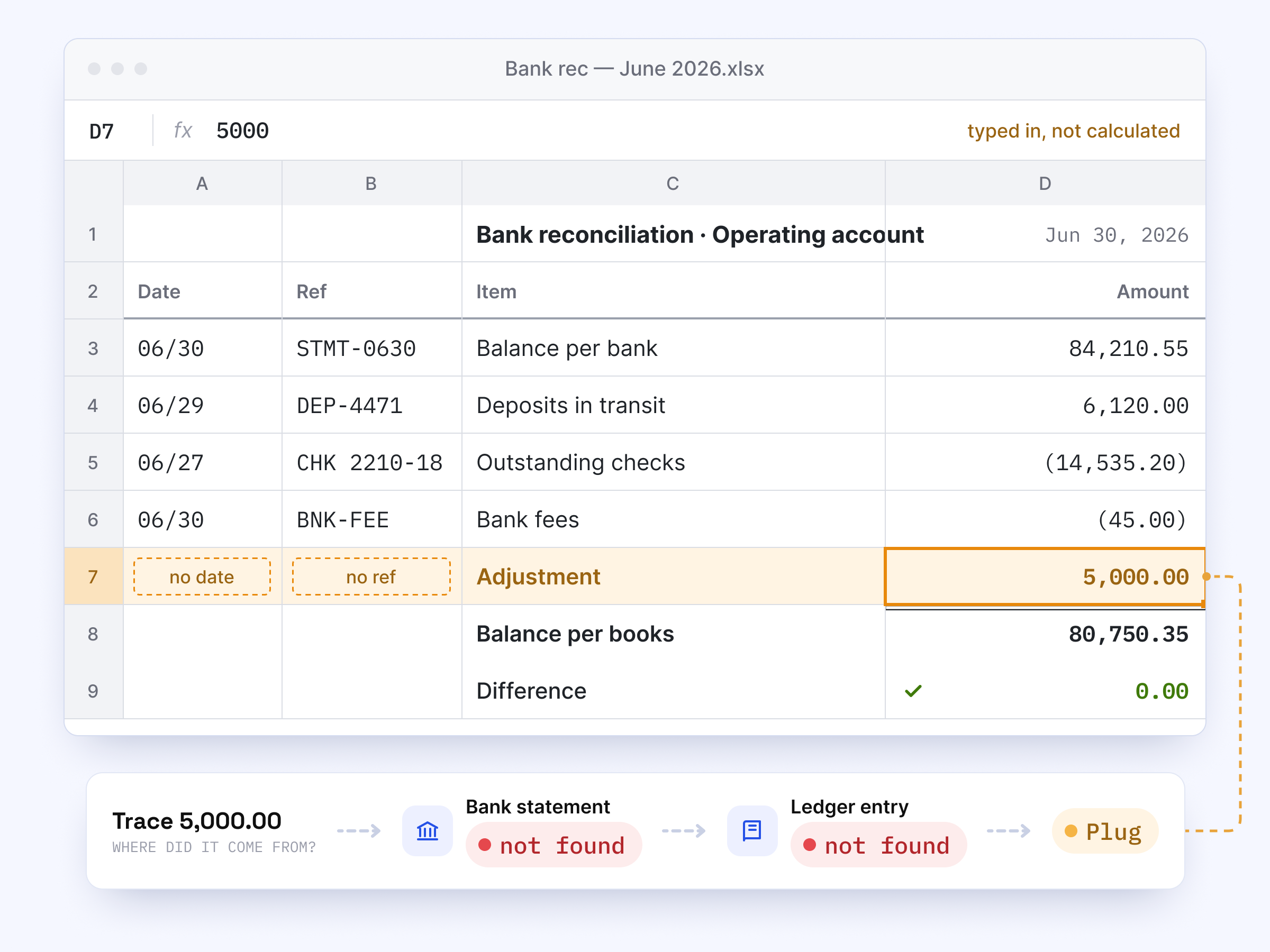
The most common manipulation in a bank reconciliation is not elaborate. It is a single line added to make the two sides meet.
It usually looks like this. The reconciliation runs down the page correctly until near the bottom, where a figure appears with a description like adjustment, timing difference, or bank error. The amount is often round. There is no document behind it. It does not appear in the following period, because it is replaced by a new one of a different size, or it appears every period at the same value, because nobody has dared to remove it.
Three questions expose it. What is this? Show me the document. Why is the same item still here three months later? A genuine reconciling item answers all three immediately. A plug produces an explanation about system differences that grows longer the more you ask.
The red flags worth knowing
Most problems in a bank reconciliation announce themselves in one of a small number of ways.
It was prepared for the audit rather than as part of the process, so it evidences nothing about the rest of the year.
Reconciliations for several earlier periods, with their preparation dates.
None of these proves anything on its own. Each is a reason to ask one more question, and the answer is usually either immediate and boring, or slow and interesting.
What makes a reconciliation easy to audit
From the other side of the table, the reconciliations that pass quickly share a few characteristics. They are worth designing for, because an audit that goes smoothly costs your team far less than one that does not.
- Every figure traces to a source. No number in the reconciliation originates in the reconciliation itself.
- Every difference carries a cause, not just an amount. An auditor who can read the reason does not need to ask you.
- Nothing sits in an unnamed category. A bucket called pending or other is an invitation to look closer.
- Preparer and reviewer are different people, and both are recorded. With dates, not just initials.
- It was prepared close to the period it covers. Evidence of a control operating, rather than a document produced on request.
- Open items are visible rather than absorbed. A reconciliation that reports an unresolved difference is more credible than one that never has any.
- Items clear. The strongest evidence that a reconciliation is real is the previous one, showing last month’s open items resolved this month.
How automation changes the work
Manual reconciliation creates most of the risks above, because a person working through thousands of lines is the thing that produces rounding, plugs and the quiet decision to let a small difference go. Automation removes the opportunity rather than the diligence.
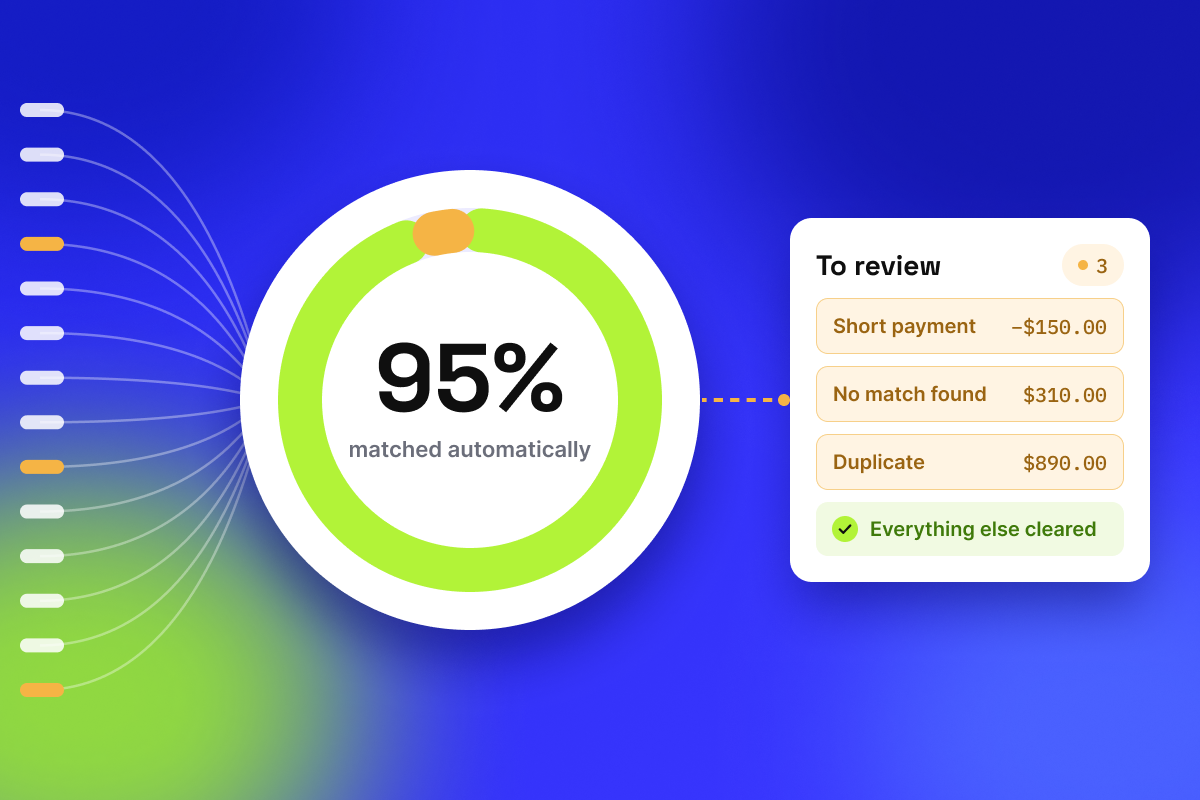
LedgerMatch matches what arrived in the bank against what you were owed, and every line comes back in one of four states: matched, variance, open or unmatched. Nothing is left in a general pending pile, which is the category a manual reconciliation uses when it needs a total to work. Each exception carries the reason it did not match and the document that would close it, so the first question an auditor asks is already answered on the page.
The connections are read only on both sides. LedgerMatch can see transactions and cannot move money, and it posts nothing to your accounting software, so it cannot be used to create an entry and then explain it away. The approach is set out in full on our reconciliation software page.
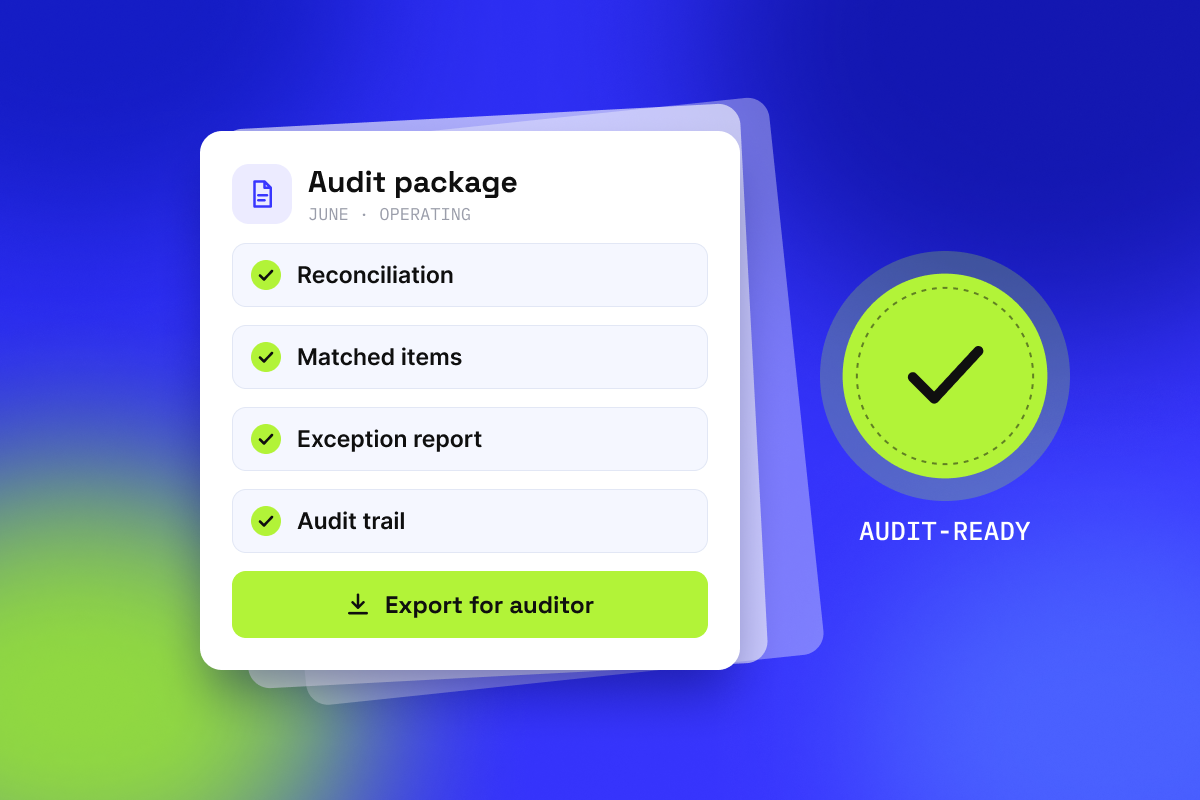
Every figure in the output traces back to a source feed or to a calculation made during matching. None of it starts inside the reconciliation, which is the property that lets an auditor re-run the result instead of accepting it. At period end, one click produces the package: reconciliation, summary, exceptions and adjustments.
What automation does not do is replace judgement. An unexplained receipt still needs someone to establish where it came from, and a long outstanding item still needs a decision. It does not operate your review control either: who prepares, who reviews and who approves stay with your team and your own process. And it does not confirm the bank balance, which still has to come independently from the bank. The audit still happens. It simply starts from evidence rather than from a spreadsheet somebody assembled last week.
The checklist
- Bank balance confirmed independently, not supplied by the client.
- Confirmation covers all accounts, facilities, security and signatories.
- Completeness of bank accounts tested separately.
- Book balance agreed to the general ledger.
- Reconciliation cast, and the formulas checked, not only the total.
- Testing threshold set, plus unusual items pulled in regardless of size.
- Every material deposit in transit traced to the subsequent statement with its clearing date.
- Interbank transfers around the period end scheduled and checked on both legs.
- Outstanding payments traced, with attention to long outstanding and late released items.
- Every other reconciling item supported by a document outside the reconciliation.
- Manual adjustments identified, with who posted them and on what basis.
- Cut-off tested either side of the period end.
- Preparer and reviewer identified, different people, with dates.
- Separation of duties considered between reconciling, recording and paying.
- Prior period reconciliations reviewed to confirm items actually clear.
See it against your own numbers
Book a walkthrough and we will run a period you have already closed by hand, so you can compare our result against yours before anything goes into production.


Become a Design Partner
Reconcile faster. Stay audit-ready
We're accepting a limited number of organizations for the inaugural cohort. No cost, 12 months, direct access to our team.
General
General
November 5, 2026
How to Connect Your Business Bank Account for Automatic Reconciliation
Connecting your bank account directly is what makes daily reconciliation possible, instead of exporting a statement once a month. This guide covers what the connection actually gives a vendor, the six questions to ask before you authorise one, and how to test the result against a month you have already closed.
General
General
November 5, 2026
How to Reconcile Accounts Receivable Without Forcing the Numbers
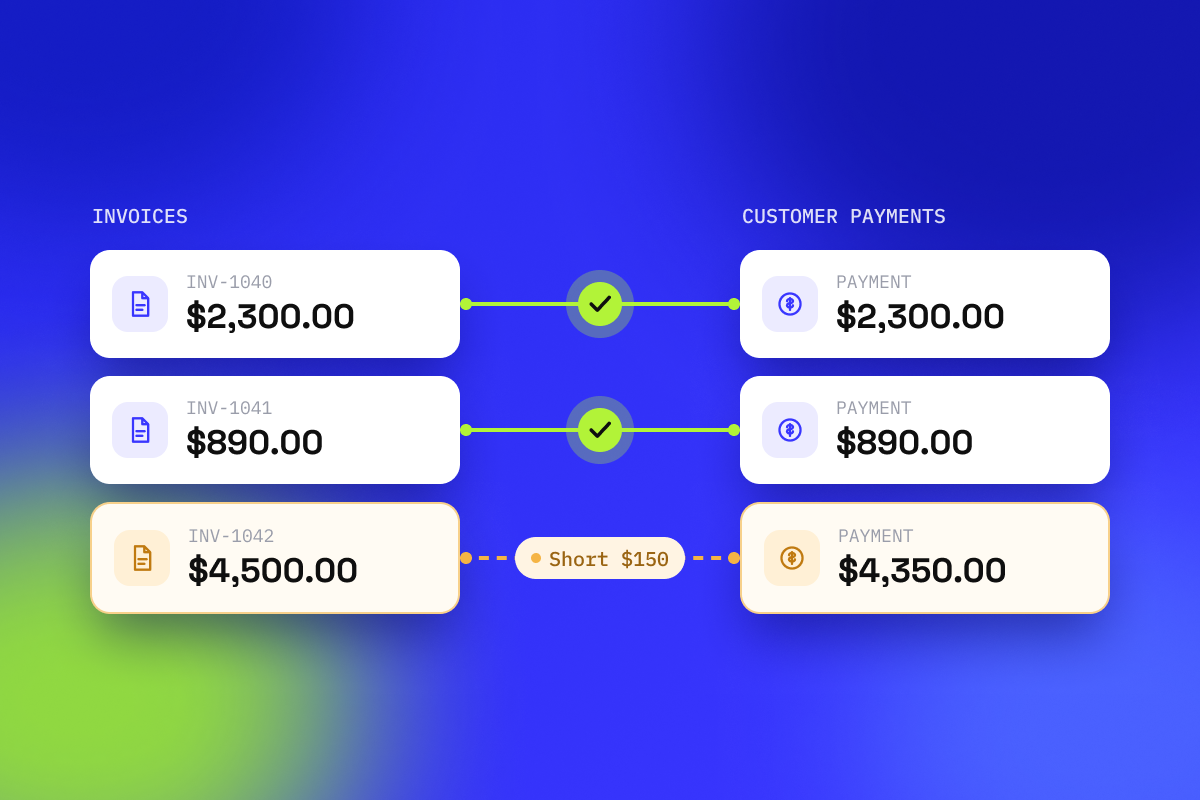
Accounts receivable reconciliation answers one question: does what customers owe you agree with the money that actually arrived. This guide covers the six-step process, the six differences that cause most of the work, and how to stop doing the matching by hand.
General
General
November 5, 2026
LedgerMatch brings automatic payout reconciliation to Clover merchants
LedgerMatch ofrece a los comerciantes de Clover una conciliación automática de los pagos
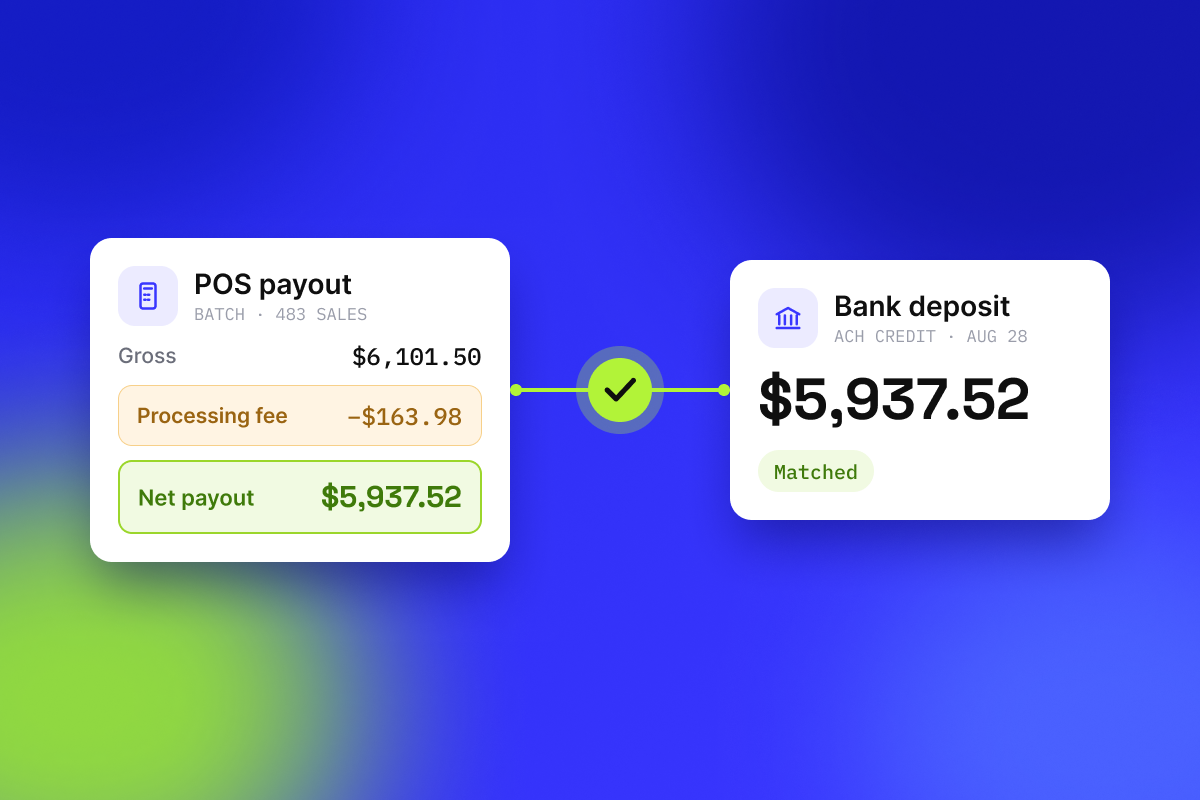
A new Clover POS integration connects card processing and the bank account on one side each, then returns only the lines that do not tie.
Una nueva integración de Clover POS conecta, por un lado, el procesamiento de tarjetas y, por otro, la cuenta bancaria, y a continuación muestra únicamente las partidas que no cuadran.