













© Urenkoff 2025
LedgerMatch and HighRadius are both reconciliation software, and both automate payment matching. They are built for different businesses, and the quickest way to tell which one fits yours is to look at what each matches a payment to.
This article compares the two: what each product is, what their published numbers measure, where the dividing line falls, and the situations where a company genuinely needs both. Everything stated here about HighRadius comes from HighRadius's own published product material, linked at the end.
What each product is built for
HighRadius is enterprise order-to-cash software. Its cash application product matches incoming customer payments to the open invoices they settle, and much of its engineering goes into capturing remittance data from wherever the payer left it: emails, PDFs, EDI files, check stubs and customer AP portals. It describes itself as purpose-built for complex, high-volume enterprise order-to-cash operations.
LedgerMatch, the reconciliation software built by Urenkoff, is a matching product for money coming in. It matches payments, card settlements and deposits against the credits that actually reached your bank, applies fees and timing differences itself, and passes a person only what is genuinely unexplained.
If you invoice your customers, HighRadius is solving the harder half of your problem. If your customers pay at a checkout, that half does not exist and ours is where the month goes.
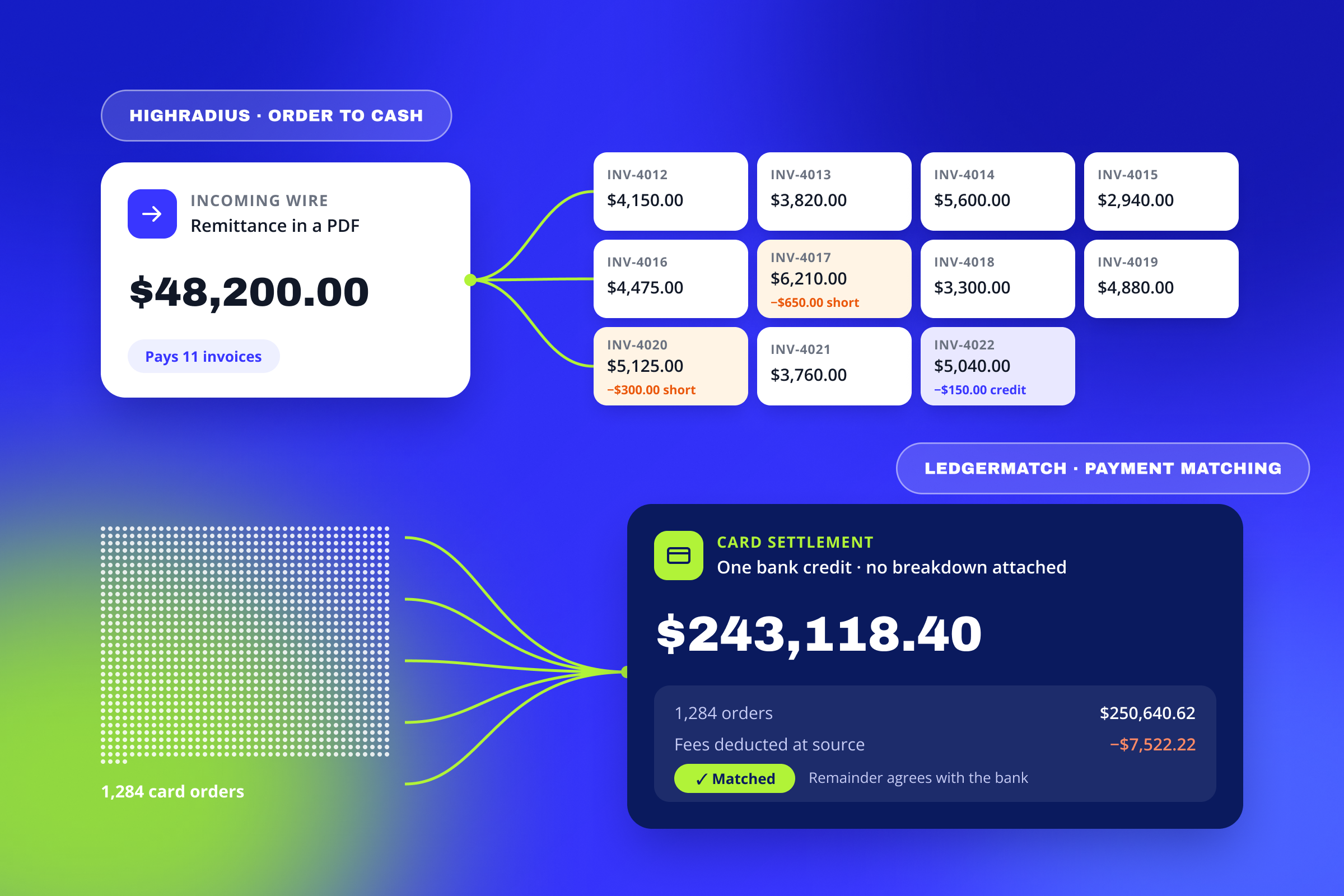
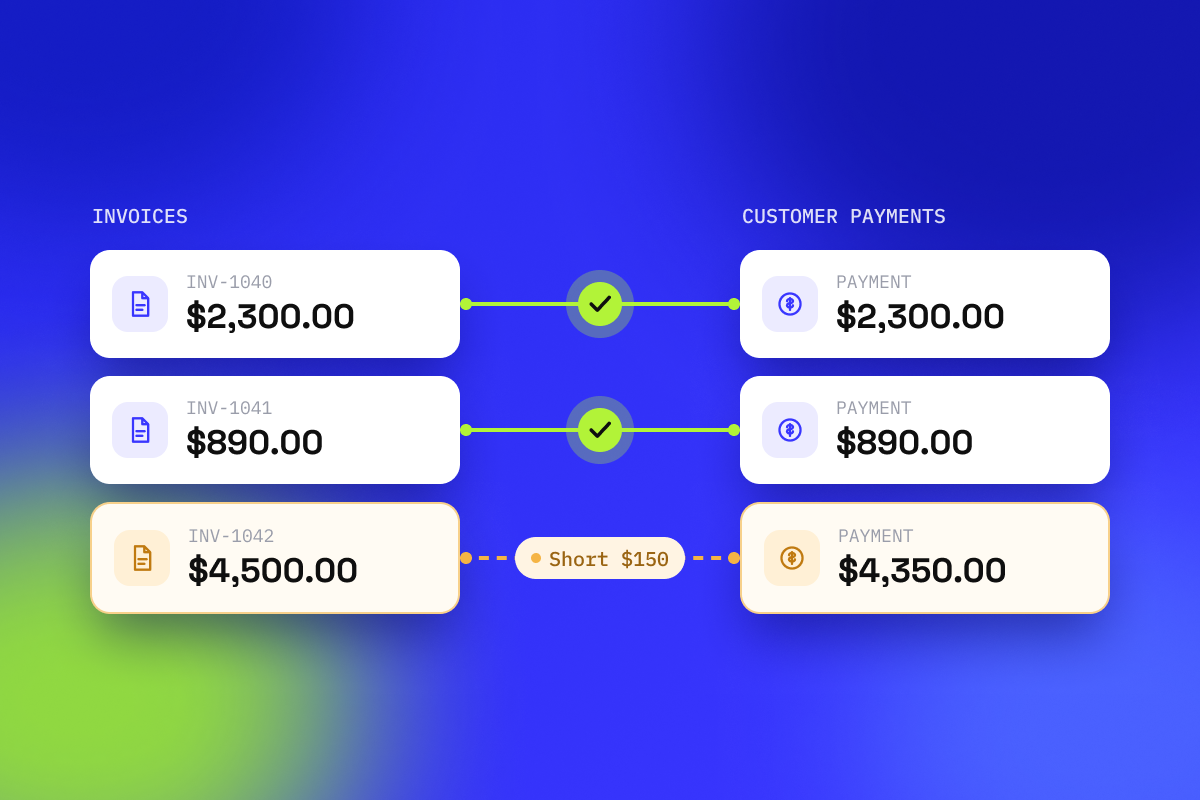
Two payments, two different questions
The distinction sounds abstract until you put two real payments next to each other.
HighRadius is built for the first payment. LedgerMatch is built for the second. A tool designed for one will do an awkward job of the other.
The dividing line: do you invoice, or do you take payments?
Almost every other difference follows from this, so it is worth settling first.
If you invoice your customers, your matching problem is attribution of a payment to invoices. The payer tells you what they are paying, badly: in an email, a PDF, a spreadsheet, an EDI file, a portal, or not at all. The work is reconstructing their intention and handling short payments and deductions. That is cash application, and HighRadius is one of the most heavily engineered answers to it.
If customers pay you at a checkout, a terminal or a marketplace, nobody tells you anything. The payment leaves as hundreds or thousands of small transactions and arrives as one batched credit, net of fees, days later. The work is proving the total that arrived matches the total you were owed, and finding the batch that never landed. That is settlement matching, and it is what LedgerMatch is built for.
A quick self-test: when money arrives, do you have to work out which invoices it pays? If yes, you are in HighRadius territory. If there are no invoices because the sale and the payment happened at the same moment, you are in ours.
What HighRadius does
HighRadius automates cash application inside enterprise order-to-cash. Its own description is "purpose-built for complex, high-volume enterprise order-to-cash operations", and the product's real achievement is in the messy part: getting remittance data out of wherever the customer left it.
Two things are worth appreciating here even if you end up choosing differently. Aggregating remittance from hundreds of customer AP portals is genuinely difficult engineering, and it is the kind of work that only pays off at enterprise scale. And the platform is wide: cash application sits alongside deductions, collections, credit and treasury, so a large AR function can run most of its world inside it.
The cost of that breadth is that the whole machine assumes invoices, an ERP and an AR team. Take those away and most of the product has nothing to grip.
What LedgerMatch does
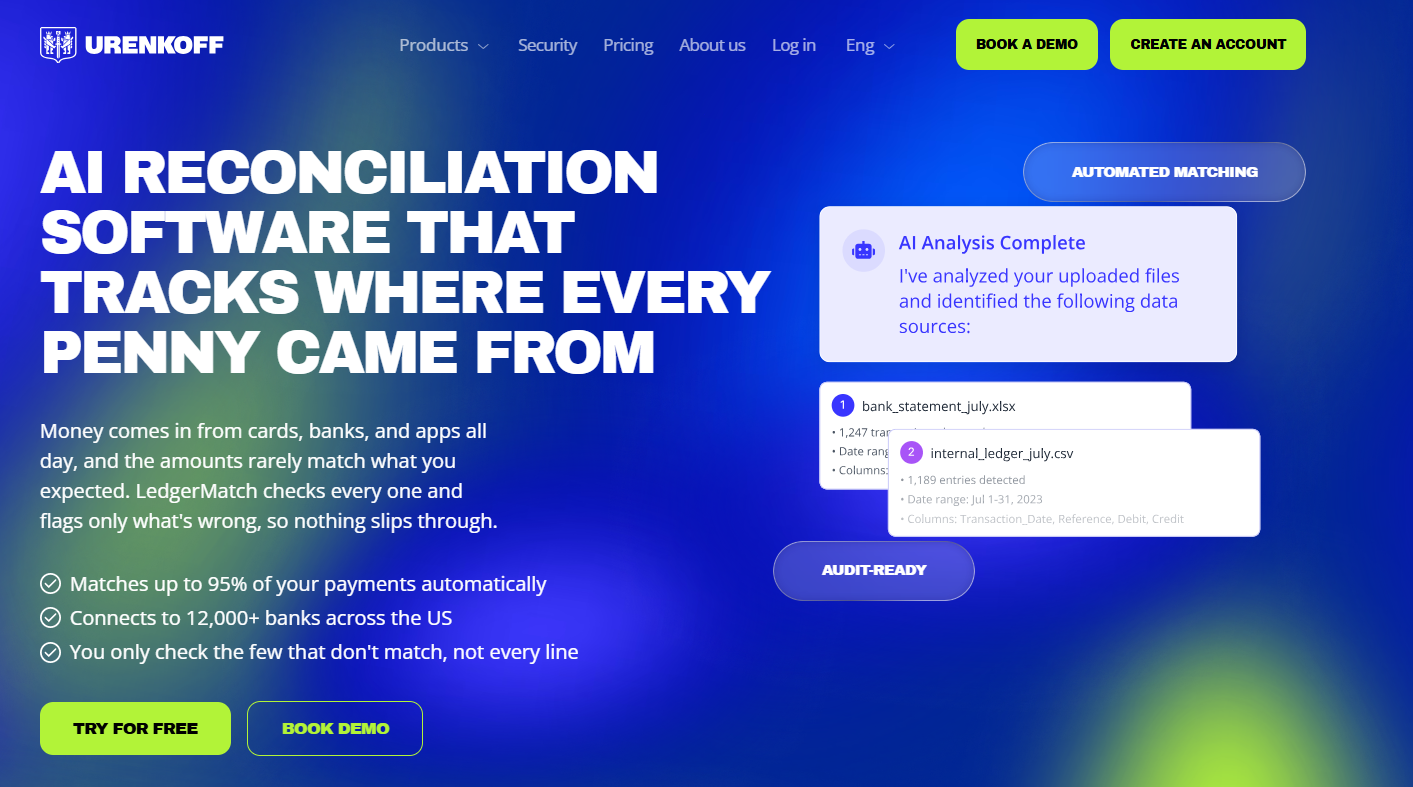
LedgerMatch, the reconciliation software built by Urenkoff, starts from the bank rather than from the invoice. It reads what you were owed and what actually arrived, matches the two, applies the fee and timing differences itself, and sends a person only what is genuinely unexplained.
It is deliberately narrow. There is no collections module, no credit scoring, no deductions workflow and no treasury suite, because the businesses it serves do not have those problems in that shape. What they have is volume, fees, timing and a bank statement that refuses to agree with anything.
The remittance question, and why it settles the argument
Most comparisons of payment matching tools get lost in feature lists. This one has a shortcut.
Remittance advice is the information a payer sends telling you what their payment is for. In B2B it is the centre of the whole problem. It arrives as an email attachment, an EDI file, a line in a portal, a scanned check stub, or not at all, and someone has to find it before a payment can be applied. HighRadius has built an enormous amount of machinery around exactly this, down to automatically emailing customers to request missing remittance and pulling data out of customer AP portals with bots.
In consumer and platform businesses, remittance does not exist. Nobody buying a pair of shoes sends a remittance advice. The payment arrives inside a batch with hundreds of others, already reduced by fees, and the only route back to the truth is the settlement data and the bank credit.
So the question is not which product matches payments better. It is which half of the problem you actually have:
- Remittance is the bottleneck and payments need to land against invoices, so cash application software earns its place.
- There is no remittance at all and payments arrive batched and net, so settlement matching against the bank is the job.
Get that right and the rest of the evaluation is detail.
What the published percentages measure
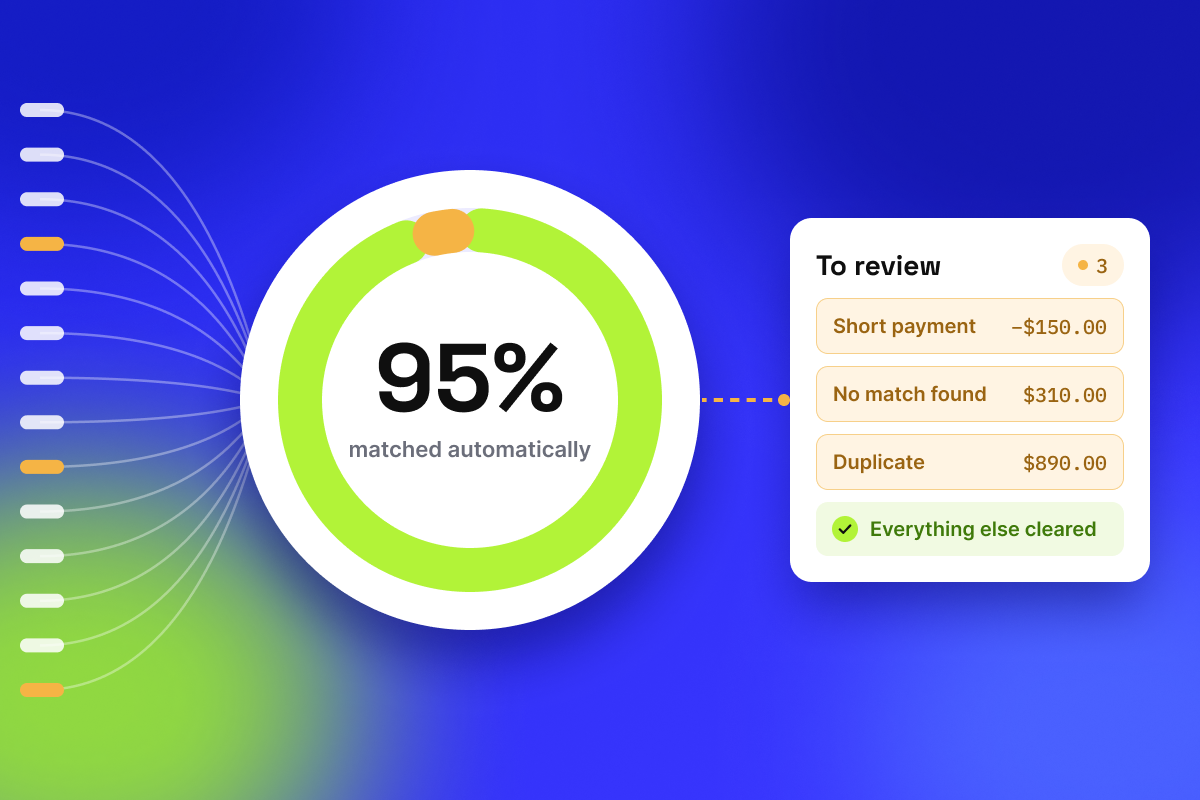
Both companies publish strong numbers, and they count different things.
Lining these up as a ranking would be meaningless. One counts invoice items applied in an AR ledger, the other counts payments confirmed against a bank statement, and both are upper bounds rather than guarantees. HighRadius also publishes named customer outcomes, which are results those customers reported rather than product specifications, and the same caveat applies to any vendor's case studies including ours.
The useful move is the same in both cases: ask to see the number produced on your own data, for a period you have already closed.
Side by side
Every row comes from the two companies' own published material. Several rows that look like a gap are simply a description of what each product is for.
When a company genuinely needs both
This happens more often than the two websites would suggest, and it is worth saying plainly.
A manufacturer that sells to distributors on invoice and also runs a direct-to-consumer webshop has both problems at once. The invoice side is remittance, deductions and AR analysts. The webshop side is card settlements landing net of fees with no breakdown. Those are not the same job, and one tool covering both well is rare.
The same is true of a B2B marketplace that invoices some buyers and takes card payments from others, or a services business moving from invoicing to subscriptions. If you recognise your company in that description, the sensible question is not which product wins, but which side of your payment mix is currently costing you the most.
What to ask, whichever way you are leaning
These five work on us as well as on anyone else you are evaluating.
- Where does the information about what this payment is for actually come from in our business?
- What does your published automation figure count, and on what kind of data?
- What will still reach a person, and how will it arrive?
- What has to exist on our side before this works: invoices, an ERP, a particular file format?
- Can we run it against a period we have already closed and compare both answers?
The fourth question is the one that catches mismatched software early. A product that assumes invoices will struggle without them, and a product built for settlements will not solve a remittance problem however good its matching is.
See it against your own numbers
Book a walkthrough and we will run a period your team has already reconciled, so you can compare what LedgerMatch says arrived against the answer you reached yourself, before anything depends on it.


Become a Design Partner
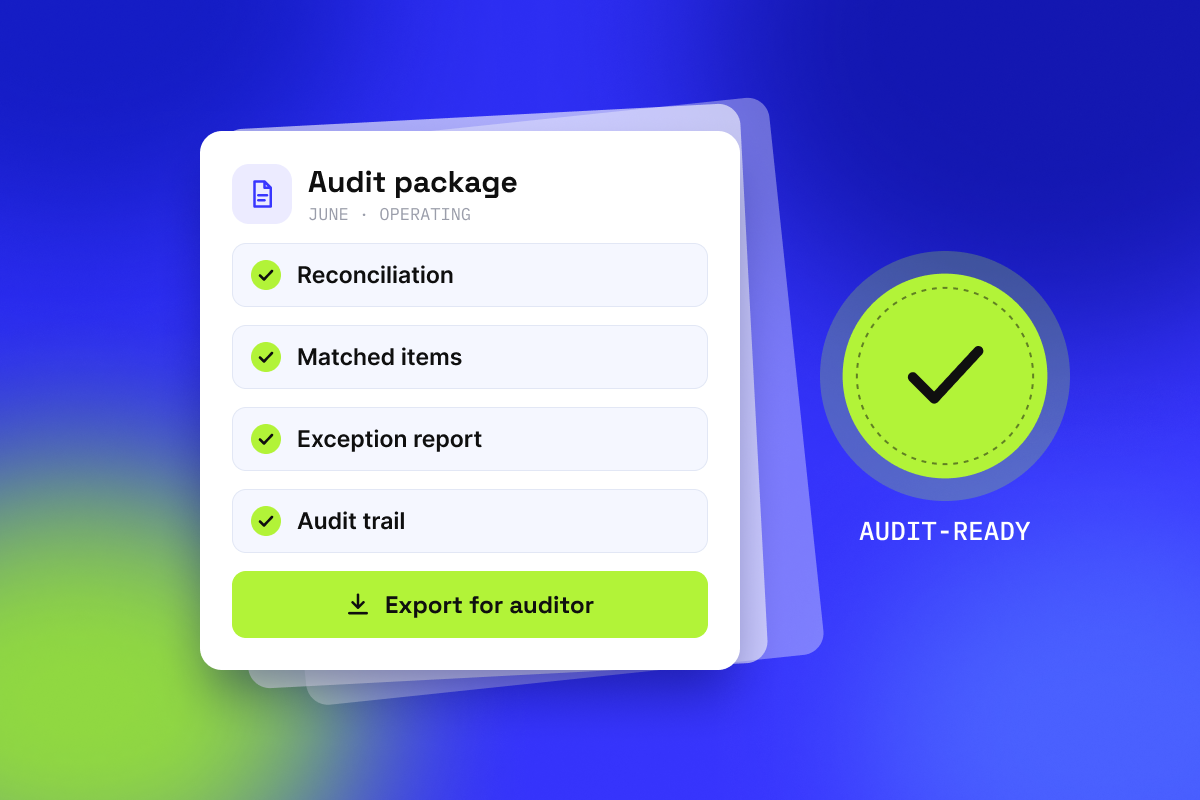
Reconcile faster. Stay audit-ready
We're accepting a limited number of organizations for the inaugural cohort. No cost, 12 months, direct access to our team.
General
General
November 11, 2026
How to Audit a Bank Reconciliation
A bank reconciliation that balances proves almost nothing. This guide covers the full audit procedure, the manipulations it catches, and the red flags worth knowing.
General
General
November 11, 2026
How to Connect Your Business Bank Account for Automatic Reconciliation
Title Post for ES Version
Connecting your bank account directly is what makes daily reconciliation possible, instead of exporting a statement once a month. This guide covers what the connection actually gives a vendor, the six questions to ask before you authorise one, and how to test the result against a month you have already closed.
Post Summary for ES Version
General
General
November 11, 2026
How to Reconcile Accounts Receivable Without Forcing the Numbers
Accounts receivable reconciliation answers one question: does what customers owe you agree with the money that actually arrived. This guide covers the six-step process, the six differences that cause most of the work, and how to stop doing the matching by hand.